
Subscribe and receive email notifications of new blog posts.
 RSS Feed
- 2026 | 33 Posts
- 2025 | 48 Posts
- 2024 | 48 Posts
- 2023 | 48 Posts
- 2022 | 48 Posts
- 2021 | 48 Posts
- 2020 | 51 Posts
- 2019 | 48 Posts
- 2018 | 29 Posts
26
Downtown Augusta: Museum in the Streets Locations
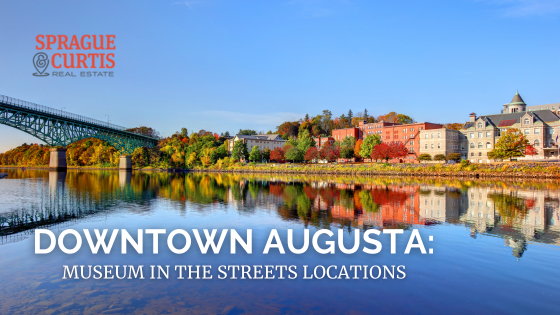
Augusta homes for sale are intertwined with a unique historical tradition: Augusta's "Museum in the Streets."
With Museum in the Streets, you have the opportunity to engage with Augusta's rich history through a self-guided walking tour that encompasses 38 different stops. Each one of the stops commemorates a significant event in Augusta, Maine's history, which runs from the earliest days up to the 1990s.
Every stop on the Museum in the Streets tour is clearly marked with a sign enabling you to understand the importance of the event that transpired on or near that spot. Museum in the Streets is a spring and summer tradition that helps to tell Augusta's unique story and how it contributes to the grand narrative of America.
Our real estate agents want you and your family to have the chance to experience it for yourself.
Explore the Compelling History of Augusta with Museum in the Streets
To review the exact location of the historic sites, see the official Museum in the Streets website. Museum in the Streets is periodically updated and also includes a second project called The Civil War Museum in the Streets Trail, which has a total of thirteen stops that are meant to be visited in order.
Let's check in with just a handful of the most memorable stops along the way:
- Cushnoc Trading Post
The very first stop on this historic trail commemorates Cushnoc Trading Post, a trading post erected by the Plymouth, Massachusetts colonists in 1628, three years after Europeans first reached Augusta. From 1628 through 1661, fur trading from Cushnoc was essential to the colony paying off its accrued debts. - Old Fort Western
By the mid-1700s, the Massachusetts colonists were ready to press their claims deeper into the New World. Trade disputes had occasionally erupted into violence, and it was time to erect a permanent fortification in 1754. It remained garrisoned until 1767 before being purchased by its first commander as private land. - Strive to Excel!
In the early 1800s, Judge Daniel Cony was one of the area's most prominent citizens. He constructed a building in 1815 that he soon announced would be an academy for girls. Under his leadership, The Female Academy opened in 1816. - Comfort Magazine
As the 1800s came to a close, Augusta developed a new and unexpected reputation as the "Mail Order Magazine Capital" of the country. One of the most noteworthy of these was Comfort Magazine, which was published from 1888 through 1942 and was a vehicle for founder W.H. Gannett's nerve tonic for women. - The First Kennebec Bridge
The Kennebec Bridge has long been an iconic local sight. Its story began in May 1797 as early construction kicked off. It was completed in November of that same year and cost about $27,000. As a result of this work, Augusta went down in history as having the very first span across the Kennebec, later replaced several times. - The Great Augusta Bank Robbery
Nearly every large city in the United States has a "Great Bank Robbery" somewhere in the annals of its history, and Augusta is surely no exception. It happened on New Year's weekend in 1850 and was reputedly a response to the new "burglarproof" vault, which criminals burrowed into at night to steal nearly $30,000.
Contact us to discover the best Augusta real estate opportunities for you.